Every December, the Christmas story sparks renewed curiosity about the gifts of the Magi–particularly Frankincense and Myrrh. But, beyond their symbolic meaning, what exactly are these substances, and what makes them distinct from one another?
What are Frankincense and Myrrh?
Frankincense and Myrrh are both aromatic tree resins that have been valued for thousands of years. Frankincense is derived from trees of the Boswellia genus, while Myrrh originates from those of the Commiphora genus. Historically, both resins have been used in perfumes, incense, and traditional medicines, prized for their fragrance and preservative properties. When processed, these resins yield essential oils composed primarily of volatile and semi-volatile organic compounds, making them ideal candidates for gas chromatography (GC) analysis.
Analyzing Frankincense and Myrrh with GCxGC-TOFMS
To explore the chemical differences between these historically significant materials, LECO scientists analyzed essential oils extracted from Frankincense and Myrrh using a Pegasus GCxGC-TOFMS system. Gas chromatography is a well-established technique for essential oil analysis, easily separating a sample into individual components. When coupled with mass spectrometry (MS), compound identification and quantification are possible. Extending the analysis into a second chromatographic dimension (GCxGC) provides a deeper level of insight.
How GCxGC Creates Structured Chromatograms
Comprehensive two-dimensional gas chromatography (GCxGC) employs two columns with complementary separation mechanisms arranged in series. This improves the separation of compounds, often allowing GCxGC to distinguish substances that would overlap in a traditional one-dimensional GC analysis.
Another benefit is that GCxGC produces clearly organized chromatograms, where similar compounds appear in predictable patterns. This makes it easier to identify compounds and quickly see the diverse types of chemicals within a sample.
Reading GCxGC Chromatograms Like a Map
As Liz Humston-Fulmer, Application Chemist at LECO, explains: “GCxGC chromatograms can be read like a map. The structured nature of the separation makes it easier to identify compound families, recognize patterns, and understand what sets one sample apart from another.” Tools like LECO’s ChromaTOF Tile Software further enhance comparison and differentiation ability, allowing labs to get confident results from their data faster than ever.
Comparing Frankincense and Myrrh Chromatograms
When comparing the GCxGC chromatograms of Frankincense and Myrrh, their differences are immediately apparent—even to the untrained eye.
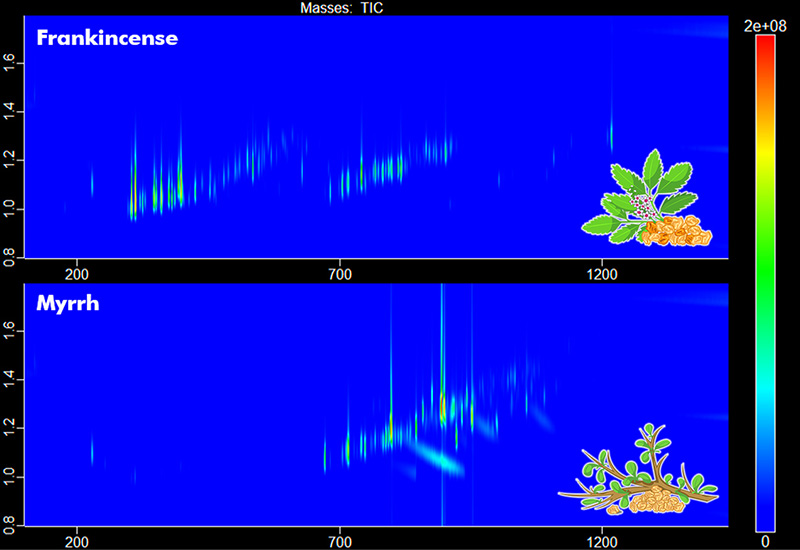
A closer look reveals specific chemicals within these compound classes that are characteristic to each essential oil. These analytes help to explain the associated aromas of the essential oil, like the warm, woody-citrus fragrance of Frankincense, or the warm, bitter, ‘earthy’ aroma of Myrrh. Understanding this composition also supports their use in perfumes, incense, and aromatherapy.
Conclusion: Modern Insights into Ancient Resins
Frankincense and Myrrh, although more commonly recognized as “ancient,” continue to remain scientifically relevant, with ongoing research into their composition and potential applications. Using the enhanced separation power and visual clarity of GCxGC-TOFMS, analysts can gain a more complete understanding of these resins of old.
For a deeper look into the chemical differences between Frankincense and Myrrh and how GCxGC-TOFMS can reveal these insights, see our full application note, Frankincense and Myrrh: Visual Characterization and Comparison of Essential Oils with GCxGC Structured Chromatograms.